
A Regional Coalition May Help Resolve Lebanon's Hezbollah Problem

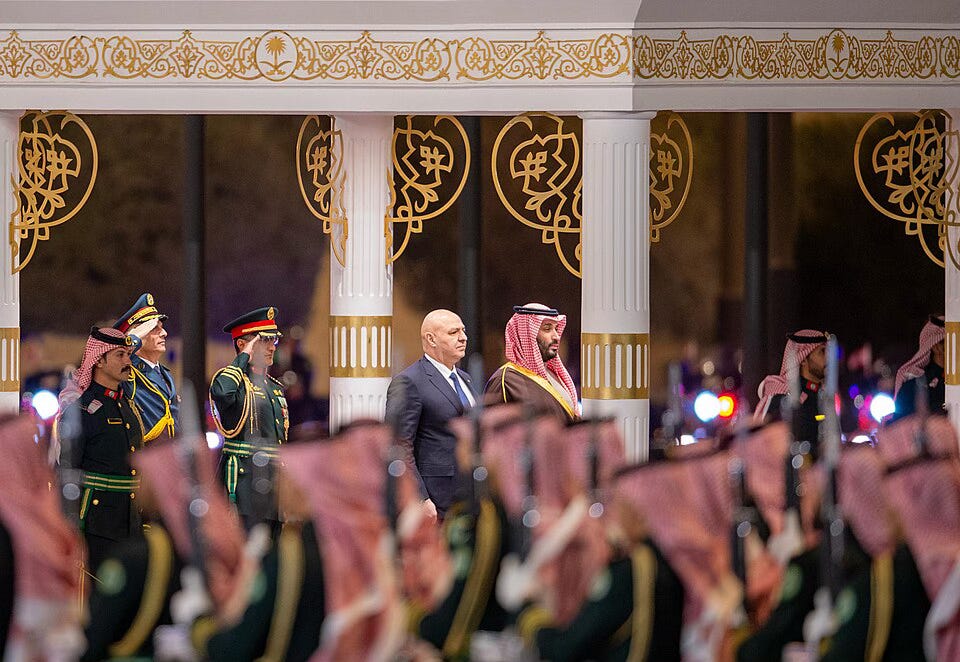
Last Wednesday, a day before the arrival in Beirut of a Saudi envoy, Yazid bin Farhan, Saudi Arabia announced it would lift all restrictions on Lebanese exports to the kingdom. The move was widely interpreted as Riyadh’s support for the Lebanese state, in particular President Joseph Aoun and Prime Minister Nawaf Salam.
The measure provided a much-needed economic boost for a country currently facing major destruction by Israel and that finds itself in the midst of a proxy war between Israel and Iran. In recent months, the Saudis have been working with Turkey, Egypt, Qatar and Pakistan to contain Israeli power in the region while also striving to reduce tensions inside Lebanon and avoid any kind of domestic conflict.
In trying to contain Israel, the five countries are not acting out of any ideological rationale. Rather, they are adopting classical “balance of power” reasoning, looking to curtail the ambitions of any single state that seeks to dominate the region in light of the anticipated void that would be left by US disengagement. These states are just as keen to prevent Iranian hegemony as they are Israeli.
With respect to the situation in Lebanon, the Saudis and their partners have sought to soften American and Israel efforts to push the Lebanese government to use force to disarm Hezbollah, fearing where this might lead. Weeks ago, Riyadh hosted Ali Hassan Al Khalil, an envoy of Lebanese Speaker of Parliament Nabih Berri, who is a major interlocutor with Hezbollah, to tell him that they did not want sectarian violence in the country.
In line with this aim, the Egyptians last year formulated a plan for the “containment” of Hezbollah’s weapons – as opposed to its forcible disarmament, which could lead to armed conflict between the group and the Lebanese army. A document outlining this plan is currently circulating and, according to those familiar with it, had Saudi input, albeit focused on full implementation of the Taif Agreement, the Saudi-backed plan that served as the basis to amend the Constitution in 1990, but was only partly applied.
The inclusion of Taif in the effort suggests that the Saudis view Hezbollah’s surrendering of its weapons – in a process described in the document as an “‘organised gradual transition’ rather than forced disarmament” – to be part of a broader effort to give the Shiite community a greater role in the state in exchange for the group’s weapons. Hezbollah presented its observations on the document, but these indicate that more negotiations are needed.
In light of this, it is interesting that Lebanon’s armed forces commander, Gen Rodolphe Haykal, was recently invited to Pakistan. It isn’t clear what was discussed, but some observers couldn’t help but tie it to Islamabad’s role as a mediator between the US and Iran. It is conceivable that the Pakistanis are helping to define a role for the army in the south that would avoid a clash with Hezbollah, one that could obtain Iranian endorsement.
The key takeaway from the initiative, however, is that Lebanon is better off relying on a regional approach to the Hezbollah problem than on a scheme designed to precipitate its armed forces into a devastating confrontation with the group. At the same time, the present ceasefire between the US and Iran creates an opening to place the Lebanese crisis on the negotiating table between Washington and Tehran, something Iran has long resisted. If this happens, the coalition’s plan could potentially represent a road map to address Hezbollah’s weapons.
That regional dynamics are coming to the fore was evident in remarks last week by Turkish President Recep Tayyip Erdogan. He declared that Israeli attacks in Syria and Lebanon threatened Turkey, effectively and explicitly expanding his definition of Turkish security. This shows how countries are beginning to define zones of influence and red lines in ways we have not seen previously under Pax Americana.
Full article at The National, which you can read by clicking here.